The central idea
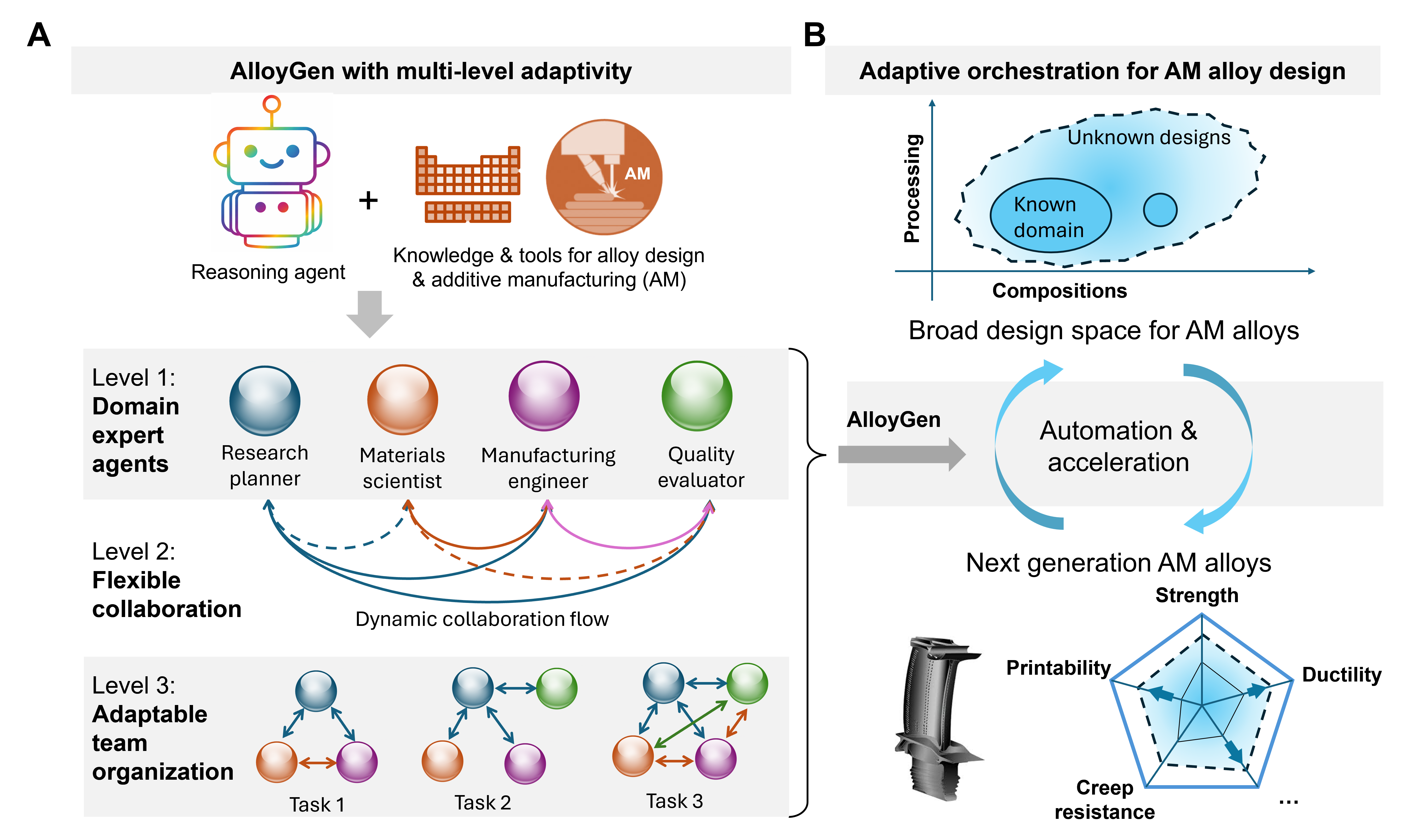
Alloy design for additive manufacturing couples composition, processing, solidification, and performance. AlloyGen makes the organization of that investigation adaptable at three levels: individual agents acquire specialized tool competence; collaborating agents develop a workflow around the task; and a team-builder determines the expertise, roles, and tools needed to carry it out.
What the preprint demonstrates
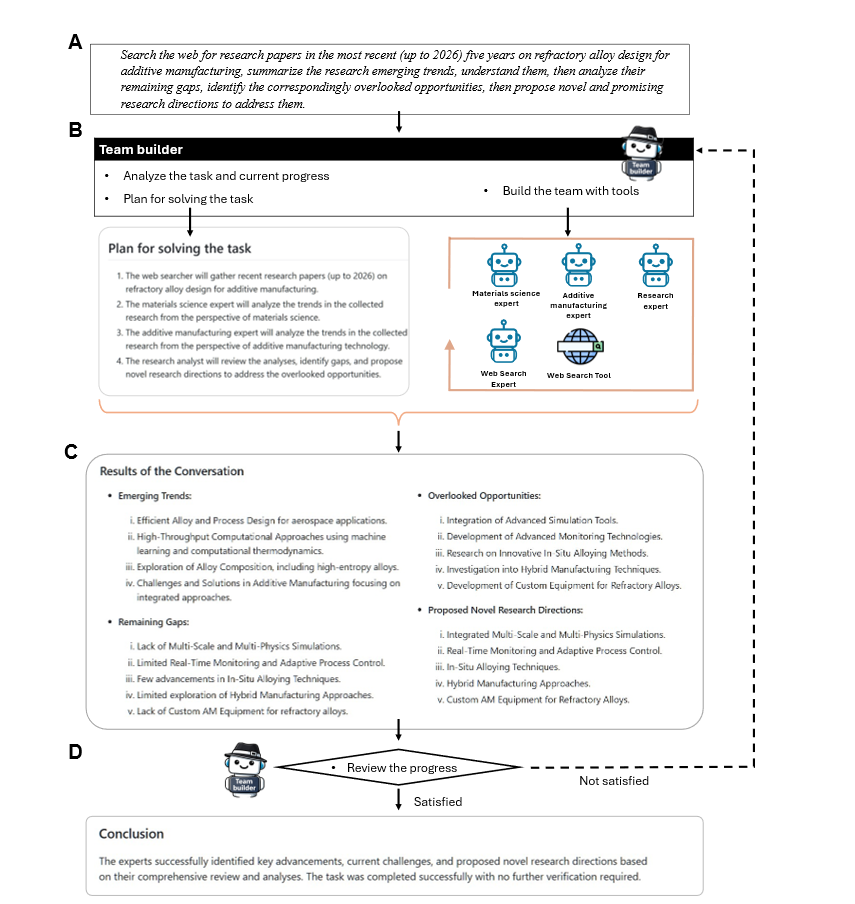
A CALPHAD expert agent completes six benchmark tasks using curated retrieval and execution feedback. A specialist team turns an underspecified Al–Si printability request into thermodynamic screening with explicit criteria and executable calculations. For a refractory-alloy research review, a team-builder assembles agents with complementary expertise, assigns tools and subtasks, and evaluates the resulting progress report.
My contribution
I am the lead and a corresponding author. I co-developed the concept and methodology, carried out the investigation and data curation, contributed to software, formal analysis, validation, and visualization, and wrote the original manuscript. S. Mohadeseh Taheri-Mousavi co-developed and supervised the work.
Scope of the result
The preprint demonstrates computational alloy-research workflows, including tool use, printability screening, and research synthesis. Experimental alloy validation and manufacturing control are subsequent steps. The team-builder supports further rounds of team construction; the reported refractory-alloy example was completed with its first team.
Adaptability at the management level
The team-builder operates above the working team. It interprets the objective, proposes a plan, selects roles and tools, and commissions a team to address the task. It then reviews the progress report and decides whether to conclude or assemble a new team around the remaining work. This makes scientific organization itself part of the adaptive process.
From Making to Mind
For Making, AlloyGen connects alloy objectives with physical models and manufacturing constraints. For Mind, it provides a concrete setting for studying the division of scientific labor: how expertise is assembled, how agents collaborate, and how the organization of a task can change with its demands.