The central idea
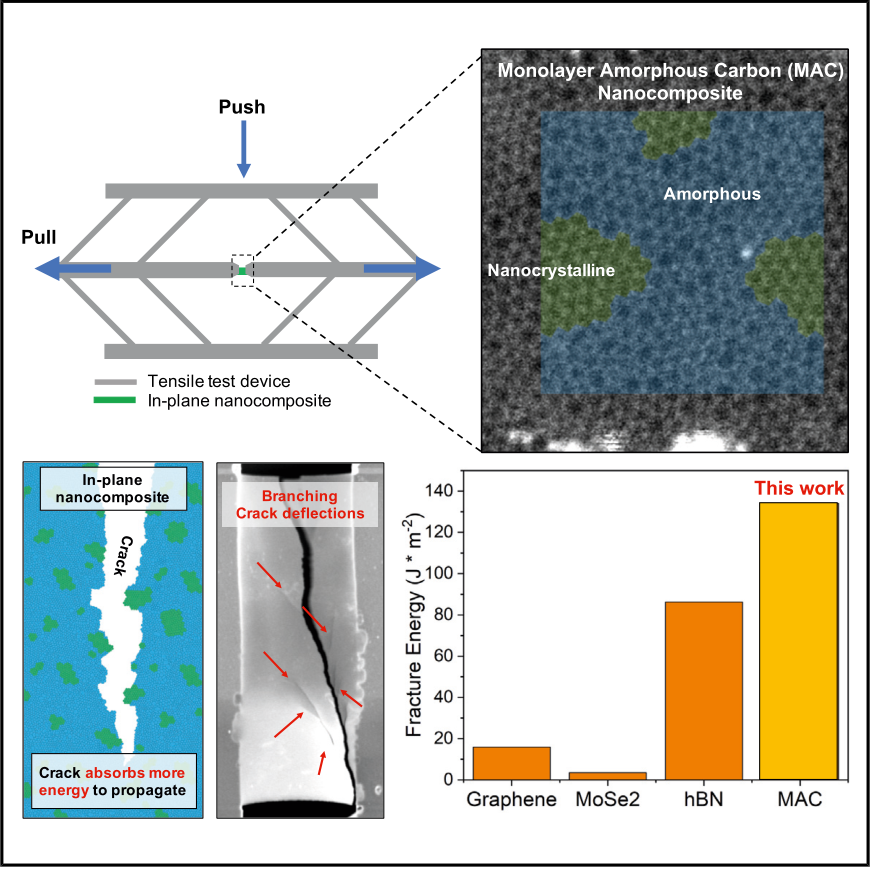
Monolayer amorphous carbon is an in-plane nanocomposite: crystalline regions sit within an amorphous matrix. Their arrangement changes how a crack advances. Local blunting, deflection, and bridging create routes for energy absorption within the sheet itself.
What the work shows
In situ SEM tensile experiments report stable crack propagation and an energy release rate about eight times the graphene comparison used in the study. Molecular dynamics identifies crack-scale mechanisms and shows how the relative areas and sizes of crystalline and amorphous domains change fracture resistance.
My contribution
I contributed equally to this collaborative study and conducted the molecular dynamics simulations with Zhenze Yang, under Markus J. Buehler, as stated in the published author-contribution record.
Scope of the result
The experimental fracture-energy comparison and the molecular simulation estimates refer to different sample scales and conditions. The simulations support the mechanisms and structural trends; they are not a numerical reproduction of every experimental value.