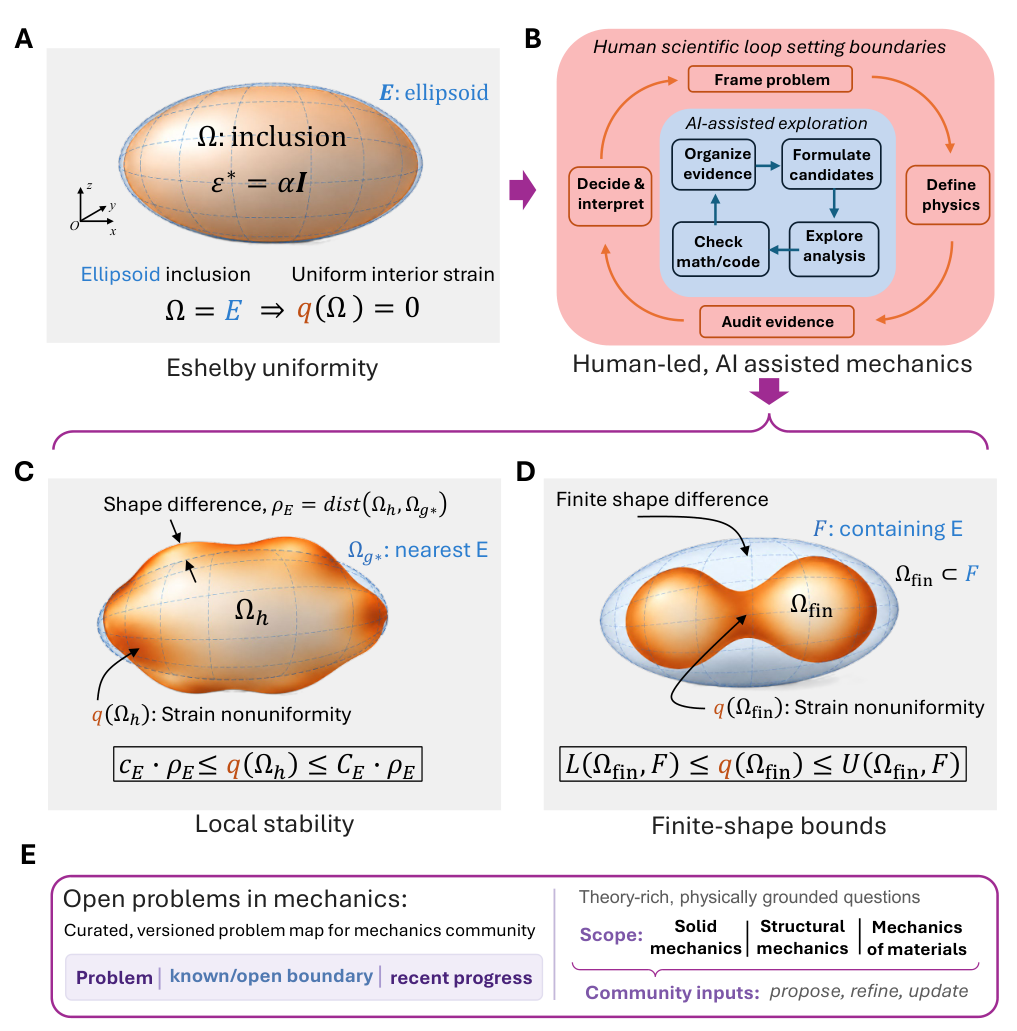
The central idea
Eshelby’s classical result gives uniform interior strain for an ellipsoidal inclusion. This study asks how that property changes as the shape departs from an ellipsoid. It develops a local theory linking strain heterogeneity to geometric distance from the ellipsoid family, and a complementary finite-shape theory with computable bounds. The mechanics investigation also provides a concrete account of human-led, AI-assisted theoretical research.
What the preprint demonstrates
Near a nondegenerate ellipsoid, nonlinear two-sided estimates connect whole-interior strain heterogeneity to a geometry-only shape distance with half-order scaling. For finite shape changes, ellipsoidal subtraction gives an exact residual budget and converging bounds. Independent finite-element calculations test protruded, indented, and necked inclusions.
My contribution
I formulated the mechanics questions, developed and audited the theory and computations, and wrote the manuscript. AI assisted analytical and computational exploration within a human-led process. This experience also motivated my Open Problems in Mechanics initiative.
Scope of the result
The results address a uniform dilatational eigenstrain in homogeneous isotropic elasticity, with the same elastic moduli inside and outside the inclusion. The local theorem applies in a sufficiently smooth neighborhood of a nondegenerate ellipsoid; the finite-shape bounds provide a complementary treatment beyond that local regime.
Human-led, AI-assisted mechanics
The human scientific loop sets the question, physical assumptions, standards of evidence, and interpretation. Within those boundaries, AI assists with analytical candidates, computational exploration, and the organization and checking of evidence. Mathematical audits and independent numerical tests connect the resulting claims back to mechanics.
Open Problems in Mechanics
This investigation motivated a shared map of theory-rich, physically grounded questions. Open Problems in Mechanics connects each problem to established results, the boundary between what is known and what remains open, and recent progress. The aim is to give theory, computation, experiment, and human-led AI-assisted research a clearer common starting point.