Imagine an AI that can tell us exactly when a new alloy will crack. It can redesign the alloy, choose a processing route, and predict the failure load more accurately than any theory we have. Its predictions survive every experiment. Then we ask why.
The answer arrives as a high-dimensional web of variables, transformations, and calculations. It is internally coherent. The AI can reason within it, modify it, and use it to solve the next problem. But no human scientist can really follow the explanation.
Have we solved fracture?
Or have we built an extraordinarily powerful technology without understanding why it works?
This distinction may become one of the central scientific questions of the AI age.
Prediction and explanation
Humans learned to predict and manipulate parts of the physical world long before modern science. Metals were made before we understood dislocations. Structures were built before elasticity became a mathematical theory. Astronomical motions could be forecast before Newton connected falling bodies and planetary motion through the same mechanics.
Prediction asks: what will happen?
Explanation asks something different: why does it happen, and can we reason from that explanation when we encounter something new?
The distinction is not simply engineering versus science. Engineers care deeply about mechanisms, and science depends on prediction. But reliable prediction can already enable action. Scientific explanation asks for another layer: a representation that can be examined, communicated, challenged, generalized, and used by another human to reason beyond the observations that produced it.
One achievement of modern science has been to bring prediction and explanation into an unusually productive relationship.
Griffith's 1921 theory of brittle fracture is a beautiful example. Solids had been breaking for millennia. His conceptual step was not merely to improve a failure-stress prediction. It was to reorganize fracture around an energetic competition between stored elastic energy and the creation of new surfaces.1 A complicated physical phenomenon acquired a compact theoretical structure.
Crystal plasticity tells a complementary story. In 1934, Taylor, Orowan, and Polanyi introduced dislocation-based pictures to explain why crystals deform at stresses far below those expected for a perfect lattice. Two decades later, electron microscopy made individual dislocations and their motion directly visible.2,3 Theory proposed an unseen mechanism; experiment later saw it.
Modern mechanics grew through this exchange. Observation suggested abstractions. Theory compressed them. Computation restored detail. Experiment pushed back.
Prediction checked explanation, and explanation made prediction transferable.
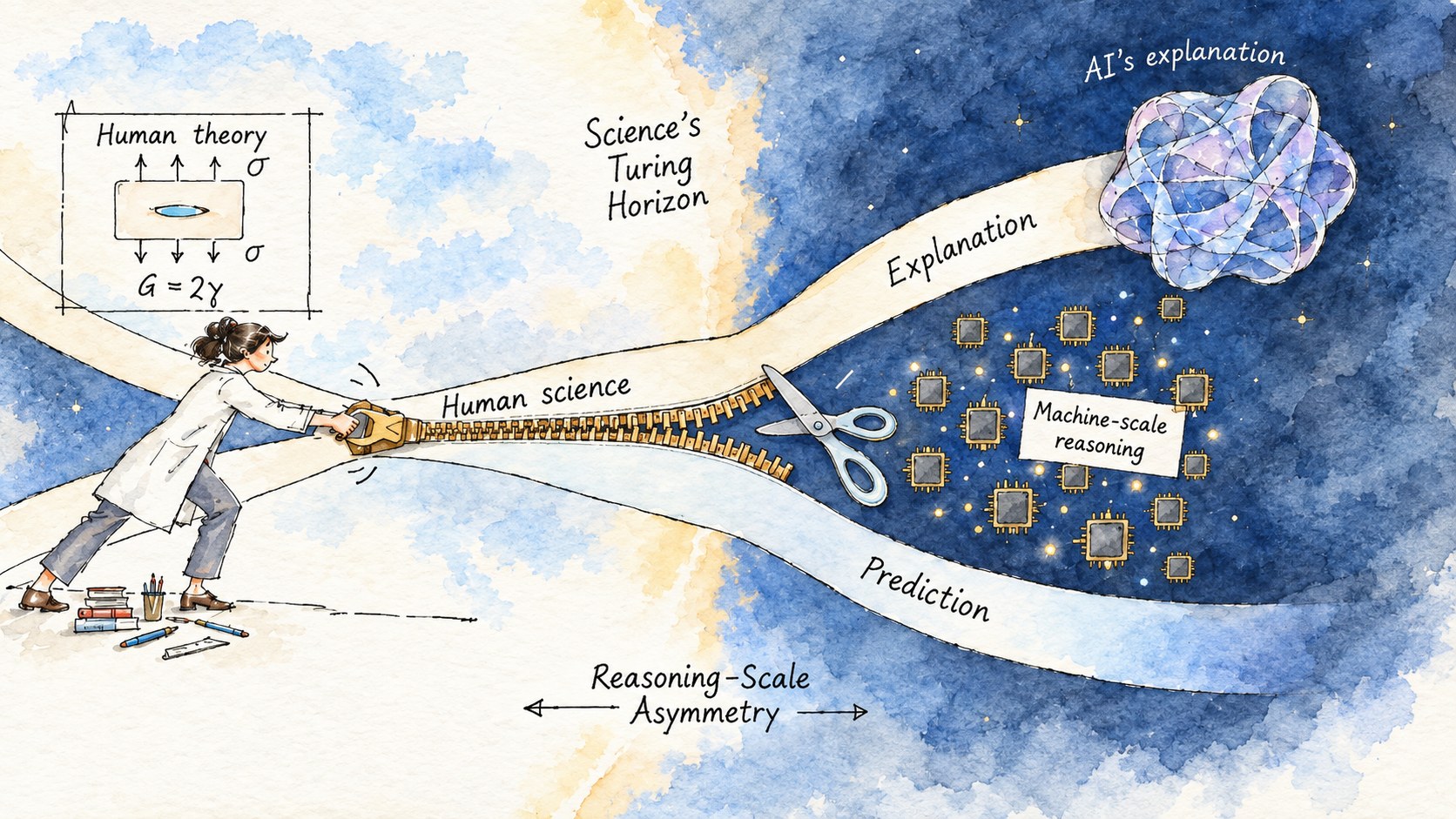
In that sense, theory has often acted like a zipper, pulling prediction and explanation into a common scientific structure.
AI may pull them apart again.
Reasoning-Scale Asymmetry
Much of today's discussion asks whether AI can reason.
A more consequential difference may be how reasoning scales.
A human researcher can explore several hypotheses deeply. A group can explore more. Science learned to scale human reasoning socially, through mathematics, writing, laboratories, journals, conferences, and institutions, but the process remains expensive. Attention is finite. Parallel exploration carries high coordination costs. Many plausible routes are abandoned simply because nobody has time to pursue them.
Machine reasoning has a different scaling structure. A reasoning process can be copied. Branches can run in parallel. Failed routes can remain available. Code can be rebuilt around a changed assumption. Large numbers of candidate hypotheses can be generated, ranked, criticized, and revisited.
Humans and AI may both reason. Their ability to scale reasoning is profoundly asymmetric.
Recent AI systems make this shift increasingly visible. Google's Co-Scientist uses multiple agents, debate, ranking, and iterative refinement, with test-time compute explicitly scaled to improve hypothesis generation.4 AlphaEvolve couples language models with automated evaluators and evolutionary search to explore large spaces of candidate algorithms.5 These systems remain early and imperfect, but the unit of AI assistance is beginning to move from an answer toward a population of reasoning paths.
The September 2026 Navier-Stokes episode makes the scaling issue unusually concrete. OpenAI reported a proof of finite-time blow-up for a forced three-dimensional Navier-Stokes formulation, together with a Lean formalization, and said the successful effort involved on the order of 10,000 concurrent agents.6 The mathematical and attribution questions surrounding the announcement are still being examined, and the physical meaning of the forced construction is being debated.7 But the event already exposes something historically new: a major mathematical argument can be generated through a reasoning organization whose scale has no close analogue in a human research group.
What happened next is just as interesting. Mathematicians began rewriting parts of the argument into forms designed for human reading and analysis; Lei and Ren describe their recent work explicitly as an accessible account of the profile-construction part of the proof.8 Discovery, formal verification, and human assimilation need not now arrive at the same time.
And the asymmetry may not stay fixed. Recent work on recursive self-improvement has begun to test whether research agents can modify and improve the machinery that performs the research itself. AIDE², for example, reports seven successive self-modifications over an autonomous eight-day run.9 Whether such loops will scale far beyond today's bounded demonstrations remains open. The durable point is the possibility they expose: the capacity to scale reasoning may itself become a target of scalable reasoning.
When reasoning becomes easier to produce, the bottleneck moves.
Which question deserves those thousand branches? Which variable deserves to survive the abstraction? Which simplification preserves the essential physics? Which result is mathematically correct but scientifically irrelevant? What evidence is genuinely independent?
When reasoning scales, choosing what deserves understanding becomes more important.
The Second Prediction–Explanation Split
This scaling difference creates a curious historical possibility.
Prediction and explanation may separate again.
The earlier separation existed because humans often had useful observations, empirical rules, or technologies before we possessed sufficiently powerful theories to explain them.
AI could create a new separation for almost the opposite reason.
Imagine that a machine develops an explanatory framework containing millions of effective variables and an immense network of relations. Suppose it is not a black box at all. The machine can perform counterfactuals within it, identify mechanisms in its own representation, transfer the framework to new physical systems, and explain its conclusions to another machine.
The problem is simply that the explanation operates at a scale no human mind can inhabit.
We could still query it. We could still receive excellent predictions. We could build safer aircraft, better batteries, tougher alloys, or new medicines. The technology might be extraordinary.
But the explanation would increasingly belong to another reasoning substrate. Prediction and explanation could both continue to advance while the gap between them widens.
The first prediction-explanation split came from too little theory. The second may come from too much machine reasoning.
This is different from the familiar problem of an uninterpretable model. A future machine may possess an explanation. It may simply not be our explanation.
That raises a deeper possibility: the same physical world may support different explanatory systems adapted to different reasoning substrates.
Humans have historically admired almost the opposite form of explanation. Our most powerful theories often achieve extraordinary explanatory compression. Newtonian mechanics is remarkable not because its equations are short, but because a small conceptual system organizes an enormous range of phenomena. Continuum mechanics replaces astronomical numbers of microscopic degrees of freedom with a small number of fields. Conservation laws expose common structure across apparently different processes.
A strong theory tells us not only what happens. It tells us what matters.
Science's Turing Horizon
In 1950, Alan Turing replaced the vague question “Can machines think?” with an operational test based on whether machine behavior could become indistinguishable from human behavior.10
For decades, the direction of the question was clear:
Can machines cross toward human intelligence?
The emergence of machine-scale reasoning suggests another boundary:
How far can scientific explanation move away from human reasoning before it ceases to be human science?
Science's Turing Horizon is not a boundary between truth and falsehood. It is not where prediction stops. It is where explanation begins to move beyond a scale humans can operate.
Beyond it may lie highly accurate prediction, useful knowledge, powerful technology, and perhaps explanatory systems perfectly coherent to machines.
The horizon instead marks the point at which the explanatory architecture of a scientific framework can no longer be operated by humans themselves.
Humans do not need to reproduce every calculation. No mechanician mentally executes millions of finite-element degrees of freedom. No experimentalist understands every transistor inside an instrument. But somewhere in the chain, the explanation must return to concepts, assumptions, and relations that humans can grasp sufficiently to reason with, challenge, communicate, and apply.
Scientific understanding has long been associated with this kind of intelligibility: a theory should function as a reasoning tool, not merely as a device that emits correct outputs.11,12
Our position here is deliberately human-centered:
The same physical world may admit many explanatory systems. Human science is the one we choose to keep within the reach of human reason.
This is not an argument for constraining AI to think like us. Quite the opposite. Machines may discover representations of nature that humans would never invent. Some may lie far beyond our natural cognitive bandwidth.
The scientific opportunity is what happens next.
Can some part of that machine-scale structure be compressed again into principles that humans can reason with? Can a million-dimensional explanation reveal three variables, one symmetry, or one conservation law that changes how we see the problem?
That is not merely an exercise in interpretability. It may become a new form of theoretical discovery.
Why mechanics?
Mechanics is unusually well placed to explore this future.
Mechanicians already move among representations with radically different bandwidth: observation, idealized geometry, continuum fields, constitutive relations, asymptotic theories, atomistic models, numerical discretizations, and engineering calculations.
Theory compresses. Computation expands. Together, they have historically helped keep prediction and explanation connected.
A continuum law compresses microscopic complexity into a few fields. Griffith's energy balance compresses complicated fracture processes into a transferable principle. Numerical mechanics expands these principles back toward realistic geometry, heterogeneity, and boundary conditions.
Seen from today's AI transition, even the history of finite-element methods takes on a different meaning. It was not only a numerical revolution. It was an earlier redistribution of scientific work: humans supplied compact physical laws and variational principles; computers expanded them into solutions for geometries and boundary conditions that human calculation could not practically carry. AI may now renegotiate that bargain by entering the formulation, abstraction, and reasoning layers as well.
Mechanics therefore does not ask us to choose between simplicity and detail. It teaches us to move between them while preserving physical meaning.
Our recent work on quantitative Eshelby stability gave us one practical glimpse of this human–AI research mode.13 The study connects departures from ellipsoidal shape to the loss of uniform interior strain, turning a classical idealization into a quantitative question about robustness. AI helped explore mathematical connections, alternative derivations, numerical routes, and checks. Yet several consequential steps came from changing the question itself: rejecting a convenient geometry measure because it violated the mechanics, recognizing that a linearized result could not simply become a finite-amplitude engineering bound, and requiring validation through an independent elasticity formulation.
The useful division was never:
human thinks; machine calculates.
AI enlarged the space of reasoning.
Human judgment determined which physical question that reasoning should serve, which abstractions were acceptable, which results were insufficient, and what evidence was needed before an answer became understanding.
Two frontiers
We should not try to keep AI reasoning permanently at the human scale. That would waste much of what makes the technology scientifically interesting.
Machine reasoning may eventually explore representations far beyond what an unaided human can operate. It may discover structures in nature that we would never find ourselves.
We should let it.
But prediction and explanation need not travel together.
One frontier is obvious: how far can machines reason?
The other may prove just as important: how much of that enlarged world of reasoning can humans turn back into understanding?
The first frontier can give us unprecedented prediction and technology. The second keeps those capabilities connected to the human project of science.
Mechanics has spent centuries compressing the physical world into forms humans can reason with, and expanding those forms again when reality demands more detail.
AI gives us vastly more reasoning to work with.
The question is how much more understanding we can build from it.
References
- A. A. Griffith, “The Phenomena of Rupture and Flow in Solids,” Philosophical Transactions of the Royal Society A 221, 163–198 (1921). DOI.
- G. I. Taylor, “The Mechanism of Plastic Deformation of Crystals,” Proceedings of the Royal Society A 145, 362–404 (1934). DOI.
- P. B. Hirsch, R. W. Horne, and M. J. Whelan, “Direct Observations of the Arrangement and Motion of Dislocations in Aluminium,” Philosophical Magazine 1, 677–684 (1956). DOI.
- J. Gottweis et al., “Accelerating scientific discovery with Co-Scientist,” Nature (2026). Article.
- AlphaEvolve Team, “AlphaEvolve: A Gemini-powered coding agent for designing advanced algorithms,” Google DeepMind (2025). Source.
- OpenAI, “On the Navier-Stokes Millennium Prize Problem” (8 September 2026). Source and proof.
- D. Castelvecchi and N. Jones, coverage of the Navier-Stokes claim and its mathematical and physical implications, Nature (September 2026). Mathematics; physics.
- Z. Lei and X. Ren, “Finite-Time Blowup for Navier-Stokes with Smooth Forcing, Part I: Construction of Self-Similar Solutions with Admissible Stress and Flat Remainder,” arXiv:2609.35406 (2026). arXiv.
- D. Srikanth et al., “Recursive self-improvement of AI research agents,” arXiv:2609.26457 (2026). arXiv.
- A. M. Turing, “Computing Machinery and Intelligence,” Mind 59, 433–460 (1950). DOI.
- H. W. de Regt, Understanding Scientific Understanding, Oxford University Press (2017).
- M. Krenn et al., “On scientific understanding with artificial intelligence,” Nature Reviews Physics 4, 761–769 (2022). DOI.
- Bo Ni, “Quantitative Eshelby stability: local and finite-shape theory through AI-assisted mechanics,” arXiv:2610.13400 (2026, preprint). arXiv.