The central idea
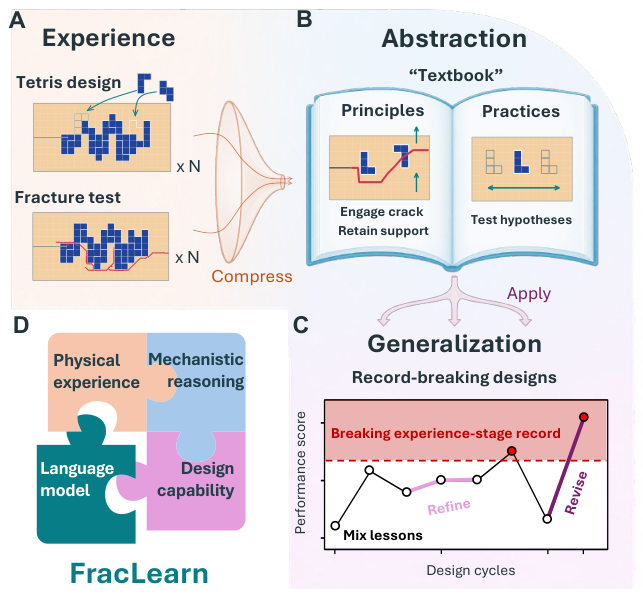
FracLearn places language models in an unfamiliar, Tetris-inspired fracture-design environment. The models propose reinforcement architectures, observe their simulated mechanical response, and abstract conditional principles that connect placement, crack evolution, and load transfer. They then use those principles in new designs and revise their hypotheses when the physical evidence reveals a failure.
What the preprint demonstrates
The best design achieves a composite score 11.0% above the experience-stage record. The score combines multiple measures of fracture resistance and load-bearing performance. Mechanics analysis connects progress to crack deflection, temporary trapping, renewed interception, and retained load capacity. The learning occurs through recorded experience and reusable knowledge, without updating the language model’s weights.
My contribution
I conceived and carried out the study, developed the design and learning framework, analyzed the fracture mechanics, and wrote the manuscript.
Scope of the result
The results concern the specified simulated brittle-fracture environment and its design objectives. They demonstrate learning through external experience and knowledge within this setting; transfer to other materials and physical tasks remains an open research question.
A failed refinement becomes a new physical lesson
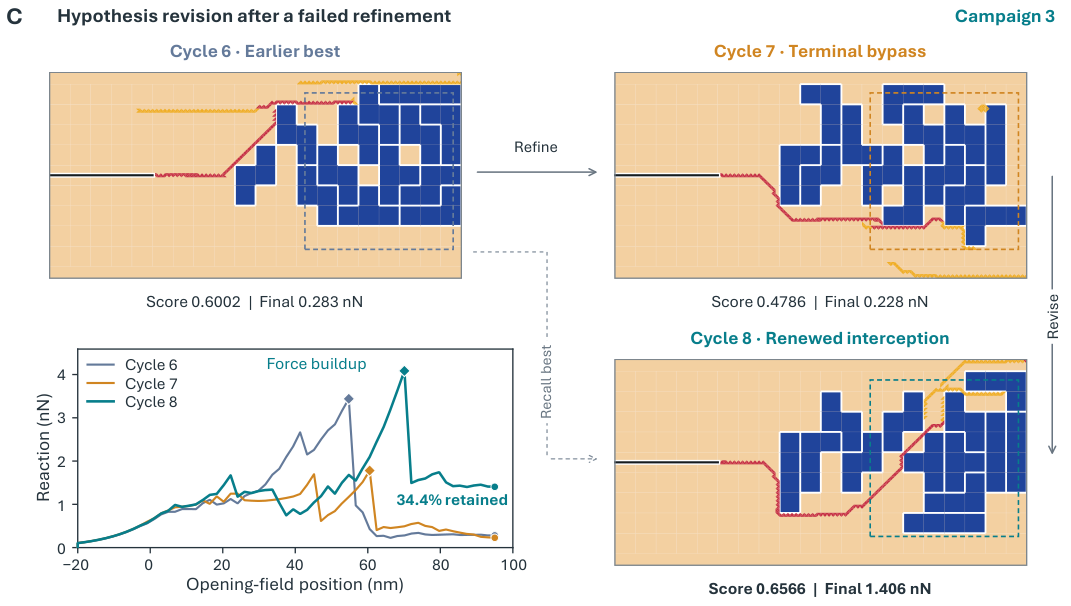
In one campaign, a promising architecture was followed by a refinement that allowed the crack to bypass the terminal reinforcement. The next design revised that hypothesis and renewed crack interception, improving the score and retaining more load after the peak. The sequence makes learning visible as a change in physical explanation and design.
A concrete question for Mind
The study asks what it means for an AI system to learn from a physical task: to construct explanations, carry them into new situations, and change them when evidence disagrees. Fracture mechanics supplies both a demanding design problem and physical mechanisms against which those explanations can be examined.